Review exam domains and objectives
For IT and security professionals, the good news is almost all certification exams are well-documented in terms of exam domains and objectives. You can quickly find the exact content breakdown for your specific exam with detailed explanations of what each section will cover.
There's no need to head into your exam confused or unsure of the content! For the most up-to-date exam topics, locate official exam outlines from your vendor, like CompTIA, ISC2 or ISACA. For example, here is the CompTIA Security+ exam outline, which includes a detailed outline of each domain, key objectives and concepts.
Thoroughly read through these lists and determine your strong points of knowledge. Breaking down a large certification exam into objectives and key concepts makes it much simpler to create a formal study plan and aligns your studying with the official exam outline and content as well.
What should you learn next?
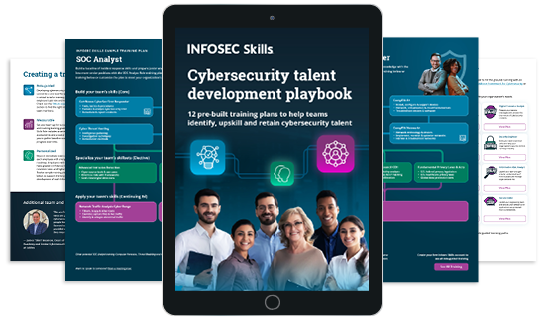
From SOC Analyst to Secure Coder to Security Manager — our team of experts has 12 free training plans to help you hit your goals. Get your free copy now.
Get familiar with the types of questions on the test
Not only is every certification exam's content well documented, but even samples of the different types of questions are available online. For example, both Security+ and CISSP have multiple-choice and more “hands-on” type of questions, which CompTIA calls performance-based questions (PBQ) and ISC2 calls advanced innovative questions.
Here are the most common question types you’ll find on exams:
- Multiple-choice: You're probably most familiar with multiple-choice questions, where there are a series of options and only one correct answer. Common tips for tackling multiple-choice questions include looking for keywords within the answers and using the process of elimination to narrow choices down.
- Multiple-response: These types of questions have multiple answers instead of a singular choice. For multiple-response questions, make sure your answers thoroughly address the questions and try to answer the question without reading the options first.
- Performance-based: Designed for more technical responses, performance-based questions (PBQs) require you to perform a task or solve a problem to answer a question. You're given a scenario and must perform the task in a simulated environment.
Most exams only have a small number of “hands-on” or PBQs, and common strategies for these include utilizing labs and hands-on practice environments within your studying to practice these simulations.
Learn tricks for your specific certification
Make sure you understand specific tricks for your individual certification to maximize performance. Each exam is a little different and comes with different test-taking strategies. For example, the CISSP exam is a Computerized Adaptive Test (CAT), meaning that the questions adapt based on how you answer the previous questions. This means:
- No going back: You cannot go back to previous questions since early questions are used to inform the difficulty of future questions
- May feel harder: The exam algorithm presents each question with the expectation you should have about a 50% chance of answering correctly. If you continue to answer correctly, you’ll get progressively harder questions.
- No exact end: The number of questions for each test taker will vary between 100 and 150. Consider this when budgeting how much time to spend on each question.
Understanding these exam expectations can help you create a solid exam strategy, but it’s also important to understand the types of answers each exam is looking for.
Steve Spearman, an expert Infosec CISSP Boot Camp instructor, recommends thinking like a manager to choose the answer with the highest order. Instead of thinking like a technician, focus on the best answer from a managerial point of view.
Practice, practice and practice the practice questions
The absolute most important element of exam prep is practicing the practice questions. There's no better way to assess yourself, pinpoint your weaker areas and feel confident going into exam day than going through hundreds, if not thousands, of practice exam questions. Find as many official, reputable practice questions as possible, and time yourself.
This is where having someone experienced to point you in the right direction can be beneficial.
“You should target doing at least 2,500 questions [to prepare for the CISSP exam],” explains Spearman. In the video below, he breaks down how you can get 2,000+ practice questions with just two resources.
So, how do you know when you're ready to sign up and take the exam? Spearman tells his boot camp students, "You need to get 75% of the answers right in the official practice test, and it needs to be questions you've never seen before."
Get your free role-guided training plans
Get 12 cybersecurity training plans — one for each of the most common roles requested by employers.
Understand how to approach questions on test day
Once it's test day, look at these five strategies to optimize your score and performance.
- Take your time: Rushing to finish the exam is the top reason students fail the exam, say multiple Infosec instructors. Make sure you understand how much time you have per question and slow down.
- Understand “distractor” answers: Some questions may have answers that appear correct at first glance but don’t quite align with the full scope of the question. For example, a technical person may answer a question about data privacy by thinking about encrypting the data; however, the correct answer may be higher-level, like not collecting the data at all.
- The Sesame Street Rule: Spearman also recommends the "Sesame Street Rule," where if one of the answers is different from the others, it tends to be the right answer. For example, if a question has three answers about router protocols and one about firewalls, firewalls is probably the right answer.
- Read the answer before the question: Tommy Gober, an expert Security+ Infosec Instructor, recommends reading the answers first to understand the choices and then reading the questions to appropriately "frame his thinking."
- Identify and remove the worst answer: One of the tips from Infosec's CISSP exam ebook is to eliminate the worst answer and focus on the other possible options. Most likely, one or two answers are completely wrong and unrelated, so eliminate those to focus on the other choices.
Quell your anxiety on the big day
Now that it's the big day, it's time to employ different techniques for overcoming your test anxiety and reducing stress levels so you can focus.
Arrive early
Spearman recommends being well-hydrated and getting to the exam site (or online site) early. If you're taking the test in person, the last thing you want to do is hit traffic or run late. Arrive at least 30 minutes ahead of time so you have plenty of time to find parking, locate the exam entrance and get settled.
Physical prep
Whether in person or online, slow, deep breathing techniques promote a calm mindset. Slow down your heart rate by taking calming breaths, and make sure you get a proper night's rest the night before. Eat a protein-rich healthy meal beforehand so you're not hungry.
For example, Jerich Beason, Chief Information Security Officer at Epiq, tells the story of how he failed his Security+ exam the first time.
He says, "I took the test on an empty stomach because this is how I spent my lunch break — no time to eat. I didn't focus on wearing comfortable clothes, nor did I get a good night's sleep." Beason eventually retook his exam, passed and now always comes prepared with his A-game.
Take the test at your best time of day
If you're a night owl or an early morning person, take the exam at your peak performance time of the day. Gober recommends scheduling the test when you're at your sharpest, such as in the morning if you're a morning person or "in the afternoon if you need a little time to boot up."
He also recommends bringing a cold drink and eating a proper, delicious meal beforehand, so you come in relaxed.
What should you learn next?
From SOC Analyst to Secure Coder to Security Manager — our team of experts has 12 free training plans to help you hit your goals. Get your free copy now.
Exam confidence and success
Overall, rest assured that a single exam performance does not make or break your career or define your personal or professional worth. Spearman advises, "Your worth as a person and a professional is more than how you do on your exam." Stay confident in the fact that you've prepared thoroughly, and you're going to do the best you can.
Also, even disappointing failures are an opportunity for growth and learning. Chris Stevens shares that failing his CIPP/C privacy exam allowed him to become a better security professional. After failing, he learned how to push through the disappointment, and re-doubled his effort to achieve success. He waited 30 days, created a strict study plan and stuck to it, focusing on the questions he missed.
Other professionals like Beason warn against being overconfident, which can lead to an initial failure. True exam confidence comes from fully understanding the material through thorough preparation and study.
Takeaways for overcoming anxiety and passing your test
Test anxiety is very real and very common, even for seasoned professionals who have taken multiple certification exams before. Preparing thoroughly with practice questions and exams is the biggest key to reducing stress and worry. Know exactly what you're going into and remain confident that you've thoroughly gone through every single objective and sub-objective.
On the actual exam, leverage your different problem-solving strategies like quickly eliminating wrong answers, reading answers first and Spearman's Sesame Street Rule. Come to your exam hydrated, well-rested and with a full meal.
If you still feel anxious walking into your test, don't worry! Research shows that a little anxiety can increase your performance, but when it becomes overwhelming, it becomes detrimental. Approach your exam with confidence, self-belief and a growth mindset.
With the right mindset and proper studying, exam success is within your reach. Don't let unwelcome test anxiety get in the way of your next big career move!