Infosec’s own data backs up the benefits of employer-paid training: 80% of students who had their certification funded by their employers reported at least one personal benefit from the training, a seven-point increase versus those who self-funded their training.
The benefits of managers supporting their employees’ education also extend to their performance in key indicators. For example, first-attempt exam pass rates, employee confidence in their skills and employee ability to tackle meaningful work all rated higher when their training was funded by their employers.
This is a trend we’ve seen over the past five years, dating back to when we first surveyed cybersecurity pros on the topic. We found that employees who get employer-sponsored training are:
- More confident in their career goals (71% vs. 56%)
- More likely to embrace transitioning into new and emerging roles (32% vs. 26%)
- More likely to have at least a somewhat clear career path (91% vs. 76%)
What should you learn next?
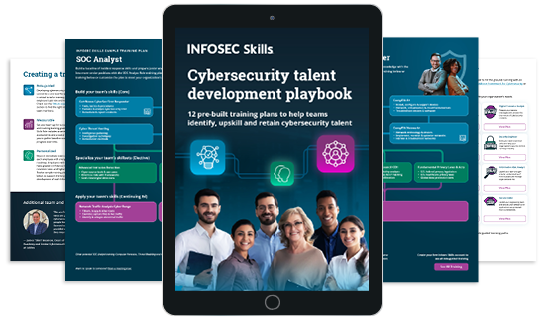
From SOC Analyst to Secure Coder to Security Manager — our team of experts has 12 free training plans to help you hit your goals. Get your free copy now.
Benefits of training for managers
Managers play a foundational role in developing and leading their teams. When managers assume an assertive role in the training process, they benefit from:
- Enhanced productivity and efficiency from their employees, whose new skills are reflected in improved performance
- Better ROI due to increased employee retention from happier, more skilled employees
- Less skills gaps within the team, which puts everyone on a more even keel
- A reduced need to retrain or hire talent from outside the organization due to higher skills and a more stable staff
In addition, you save time because you take control of the training process and its timeline. And as employees require new skills faster, the overall morale of your team improves.
It’s important to remember that you are a crucial member of your team as a manager. Therefore, when you take the lead and invest in your development, you set a powerful example for your team members.
You can do this by using training to:
- Enhance your leadership skills by learning innovative ways to inspire your team to perform at a high level.
- Learning the soft skills necessary to help team members produce their best work will improve your ability to guide and mentor them.
- Staying current with industry trends and best practices ensures that your leadership methodology remains innovative.
Crafting a convincing proposal
Your training proposal is much more than a request for money. It’s a chance to connect with a decision-maker around a common goal: improving your workforce. As a manager, to make sure you and the higher-ups align when it comes to investing in employee education, you should include the following elements in your proposal:
- A detailed explanation of the certification or training program. Be sure to emphasize its value and the relevance of the skills each team member will learn. This will help a decision-maker connect the dots between the training and favorable outcomes.
- Specific skills learners will acquire. Identify how those skills benefit your organization’s cybersecurity program. In your proposal, it’s better to focus on these key skills and their expected impact rather than simply listing every potential skill the training addresses.
- Provide a clear breakdown of the costs. Include the costs associated with preparing for the certification (training) and taking the exam (exam voucher). This will make it easier to calculate and demonstrate the training’s ROI.
- Opportunity for discounts. Training a group of employees or pre-purchasing training in bulk can lead to significant savings. Include these discounts so leadership can get the full picture and so they know you’re providing the best possible price.
- Potential challenges and how to overcome them. For instance, if employees need time away from work to attend a live training, be sure to cover why you feel that requirement is important and how you plan to meet staffing requirements during that time.
Training proposal template
Your goal is to help your team help you. While there are many ways to leverage a proposal to train your employees, here’s a sample proposal that an employee recently used to successfully obtain funding from their employer for a live certification boot camp. You can also download our Infosec boot camp justification templates for templates specific to Infosec training or modify the sample proposal below you make your case to your employer:
You can share this with your employees to help them make the case for training, which you can then modify to make the case for your leadership for approval.
Dear (APPROVER)
I would like to take training and earn a certification on [name of certification or course].
I feel that the return on the investment would be significant because this training aligns directly with the priorities of our department and my personal performance objectives for this year. The following elements of the training are particularly relevant to our situation:
-
- Element 1
- Element 2
- Element 3
Through research, I’ve found a good-value boot camp that starts on [month, day] in [city/online]. I’ve attached the course brochure. The course will be provided by [training institution], a leading training organization with excellent ratings and reviews.
[Add links or more details on the reviews, if desired]
I believe my attendance will be a cost-effective investment for our company. In addition to the skills covered by the boot camp, I will network with people from other organizations to exchange ideas, best practices and lessons learned. After the training, I can apply the knowledge I’ve gained and share the insights I’ve picked up.
I’ve worked with [my manager] to arrange for others to cover my responsibilities when I attend the course and take the exam. Additionally, if we decide to send a group to the course, we can save [X%] by taking advantage of group discounts.
I am seeking approval for the course registration fee of [cost]. To receive the pre-course materials, I would need your decision at least 14 days before the course starts.
Please approve this proposal to attend, as I’m confident in the significant ROI it will bring [organization].
Thank you for your consideration,
(signed)
Get your guide to the top-paying certifications
With more than 448,000 U.S. cybersecurity job openings annually, get answers to all your cybersecurity salary questions with our free ebook!
Funding sources in the private sector
Understanding the benefits of training and how to craft a convincing proposal are just two aspects to consider. You must also understand how your organization will pay for the training. Even if a paid training program already exists, be sure your leadership knows about these popular funding sources and benefits.
Education benefits management programs can be powerful tools for streamlining the funding process. These organizations not only provide funding options, but they also help ensure your employees get the training they need. In this way, they can be an invaluable resource in your employee development system. There are a variety of ways these organizations can fund the training your team members need.
Education benefits management programs
In many cases, one of these organizations may already have a relationship with your company. For example, Ed Assist and Guild Education often establish partnerships with organizations to help employees get the necessary training.
The process is relatively straightforward when your company uses an education benefits management provider. First, you choose a course — either one you’ve found or one from the company’s approved list. Then, the education benefits company facilitates payment directly from your organization to the course provider or certification.
It’s best to ask your HR manager which education opportunities exist in your company.
Tax benefits for training
Your organization can also use tax exclusions to reduce its tax burden if it invests in employee education. For example, they could exclude the amount spent on employee education from its taxable income. For instance, if your organization’s taxable income was $2,500,000 for the year and they spent $50,000 on cybersecurity training, their taxable income would drop to $2,450,000.
If the training “has a reasonable relationship to your business,” it could qualify. Your company can exclude up to $5,250 of educational assistance provided by each employee. Of course, you should confirm these benefits with your organization’s finance and legal representatives.
To take full advantage of these benefits, your employer can:
- Enroll multiple employees at the same time
- Time the course to maximize the benefits to the company's tax budget. For instance, if the company made more than it expected to in 2024, it could have you enroll in December 2024. In that way, it can use employee education exclusions to reduce its tax burden for that year.
Funding sources for veterans
Veterans often make good cybersecurity professionals because they often have experience in defending an organization from threats — both digital and otherwise. This makes it easier for them to “think like an attacker.” Also, thanks to their training, veterans are often skilled problem-solvers and work well under pressure — both of which are great soft skills to have when fighting cyber threats. Lastly, they may already have security clearance, which can benefit employers.
The GI Bill, which helps vets pay for their education, can cover some or all of the expenses associated with a certification or cybersecurity training. Another organization, VetsinTech, specifically supports veteran (and their spouses) transitioning into the tech workforce. VetsinTech connects veterans with employers and offers educational programs to prepare them for success in the tech arena.
The Workforce Innovation and Opportunity Act (WIOA)
The Workforce Innovation and Opportunity Act (WIOA) is intended to improve the American public workforce system by helping those with barriers to employment get high-quality jobs. It also helps employers hire and keep skilled employees. It partners with the Department of Labor, the Department of Education and Health and Human Services to enable a wider range of people access to the employment they need.
To learn more about this program, you can browse the CareerOneStop Business Center or contact your local American Job Center via the CareerOneStop website. Using the search box, you enter your employees’ zip codes and then reach out to one of the organizations in the search results.
Get your guide to the top-paying certifications
With more than 448,000 U.S. cybersecurity job openings annually, get answers to all your cybersecurity salary questions with our free ebook!
Takeaways for empowering your team through training
By investing in employee training, you help individual team members grow and pave the way for success across your organization. As your employees’ confidence and skills grow, so do their job satisfaction and retention numbers. As team members become more skilled, their productivity and quality of work increase, benefiting the entire organization.
As a manager, it’s important to advocate for the resources you need to pay for employee training because you can be the bridge between a company that’s keeping up with the competition and one that’s leading it. If you already have a training program in place, ensure you’re helping to maximize its use. If you don’t have a program, you can act now by looking into funding opportunities for your team and yourself.
Embracing a culture of continuous learning and development helps keep your teams ahead of cybercriminals and other malicious actors. Training your workforce not only empowers your team, but also creates a safer, more productive environment where everyone can thrive.