
Incident response procedures: Essential steps for effective cybersecurity

Article content
When cyber incidents happen, you need an incident response plan to protect your organization. Here's what you need to know.
Cyber incidents will eventually strike your organization. The difference between a minor disruption and a catastrophic breach often comes down to one critical factor: how prepared your team is to respond when an attack occurs.
An effective incident response plan serves as your organization's playbook during the chaos of a cyberattack. Without this framework, teams waste precious time figuring out their next steps while attackers expand their foothold in your systems.

Become a SOC Analyst: get Security+ certified!
More than 47,000 new SOC analysts will be needed by 2030. Get your CompTIA Security+ to leap into this rapidly growing field — backed with an Exam Pass Guarantee.
Considerations for creating an incident response plan
Building an incident response plan requires careful consideration of your organization's unique risks, resources and regulatory requirements. Security teams must establish foundational elements that will guide their response efforts.
Categorizing and documenting incidents: A clear classification structure forms the backbone of effective incident response procedures. Establish categories based on attack types, such as ransomware, data exfiltration and denial-of-service attacks. Then layer in severity ratings reflecting business impact. Create standardized documentation templates that capture essential details, including timeline, affected systems, actions taken and outcomes. This documentation proves valuable for refining incident response techniques and demonstrating compliance.
Roles and responsibilities: Define clear roles before incidents occur. Who declares an incident? Who leads technical response? Who handles communications? Create role cards outlining specific responsibilities during each phase of the incident response workflow. The incident commander coordinates overall efforts while technical leads oversee containment, and communications coordinators manage messaging.
Reporting and escalation: Map clear thresholds triggering notifications to different stakeholders. A suspicious email might only require notification to the security team, while a ransomware attack demands immediate executive involvement. Create escalation matrices specifying notification timeframes. For example, 15 minutes for critical incidents, 72 hours for regulatory requirements.
Cyber incident response teams: Your team needs diverse skills that span both technical and non-technical domains. Forensics specialists analyze malware, network engineers understand traffic patterns and administrators know your environment. Legal counsel guides disclosure decisions while HR handles insider threats. Many organizations supplement internal teams with incident response retainers providing specialized expertise during major incidents.
Exercise: Testing transforms paper plans into muscle memory. Start with tabletop exercises, walking through attack scenarios. Progress to technical simulations testing actual capabilities. Can your team isolate infected systems? Do backup procedures work? Regular testing builds competence while identifying improvement areas.
Key incident response frameworks
Several frameworks provide structure for building incident response capabilities. Two popular ones include:
- NIST SP 800-61 Rev. 3 provides current incident response recommendations aligned to the NIST Cybersecurity Framework.
- ISO/IEC 27035-1:2023 offers international guidance for information security incident management.
There are others you can find and use as well. Each framework shares common elements while offering unique perspectives. Organizations often blend elements from multiple frameworks, creating customized approaches fitting their specific needs.
6 steps of an incident response process
Effective cybersecurity incident response follows a structured methodology, ensuring nothing falls through the cracks during high-pressure situations. These security incident response steps provide a clear roadmap for your team.
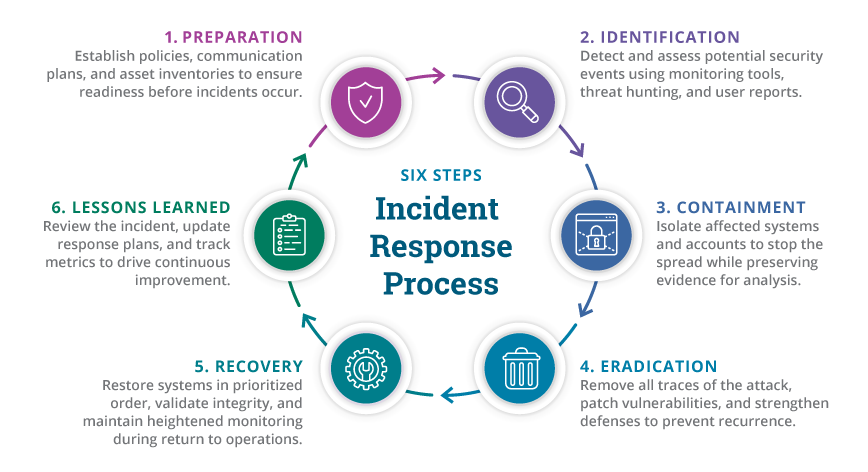
1. Preparation
Preparation encompasses all activities before incidents strike. Develop comprehensive policies establishing your approach to security events. Define what constitutes an incident and create playbooks for common scenarios, such as ransomware, business email compromise and data theft.
Establish primary and backup communication methods that remain available even if systems become compromised. Run regular training covering both general procedures and role-specific responsibilities. Subscribe to threat intelligence feeds providing early warning about attacks targeting your industry. Review your incident response methodology annually, incorporating lessons from incidents and exercises.
Asset inventory and system documentation prove critical during incident response. Maintain current inventories of hardware, software and data assets, including their criticality ratings and recovery priorities. Document system dependencies, network diagrams and administrative access procedures. When incidents occur, this documentation facilitates informed decision-making about containment strategies and recovery sequencing.
2. Identification
Detection marks the transition from preparation to active response. Deploy multiple detection capabilities: SIEM platforms aggregate logs and apply correlation rules, EDR tools monitor individual systems and network monitoring watches for unusual patterns.
Train your workforce to recognize potential incidents. Unusual pop-ups, unexpected behavior or suspicious emails could indicate compromise. Create simple reporting mechanisms that route directly to security teams. Initial assessment determines scope and severity, gathering indicators like affected systems, unusual processes and network connections to guide response actions.
Threat hunting complements automated detection by proactively searching for signs of compromise that evade traditional security tools. Experienced analysts examine network traffic patterns, review privileged account usage and investigate subtle anomalies that automated systems might miss. They look for living-off-the-land techniques where attackers use legitimate tools for malicious purposes. Regular threat hunting exercises often uncover dormant infections or persistent threats that have bypassed perimeter defenses.
3. Containment
Containment prevents bad situations from escalating into catastrophic events. Short-term containment stops immediate threats by isolating infected systems, disabling compromised accounts and blocking malicious IP addresses. These actions buy time while limiting damage.
Long-term containment builds temporary infrastructure that helps maintain operations during response. Route email through backup systems or implement additional controls while denying attackers access. Preserve evidence during containment. Capture forensic images, network traffic and logs in accordance with proper chain of custody procedures.
Network segmentation strategies significantly impact containment effectiveness. Organizations with properly segmented networks can isolate incidents to specific zones, preventing attackers from reaching critical assets. Implement micro-segmentation where possible, creating granular security zones around high-value targets like customer databases or intellectual property repositories. During containment, these boundaries become defensive chokepoints where security teams concentrate monitoring and apply additional controls.
4. Eradication
Eradication completely removes the attacker's presence. Comprehensive forensic analysis reveals the initial vector, accessed systems and deployed tools. Understanding the complete attack chain ensures you address root causes, not just symptoms.
Remove all attack traces: delete malware, remove unauthorized accounts, patch vulnerabilities and replace compromised credentials. Strengthen defenses based on attack lessons. If attackers exploit unpatched systems, accelerate patch management. Every incident provides improvement opportunities.
Supply chain considerations add complexity to modern eradication efforts. Attackers are increasingly compromising third-party software or services to reach their ultimate targets. During eradication, examine connections to external vendors, cloud services and software update mechanisms that attackers might have compromised. Reset API keys, rotate service account credentials and verify the integrity of third-party components. Contact vendors whose products showed signs of compromise. They need to investigate their environments while you clean yours. This collaborative approach to eradication prevents attackers from maintaining access through trusted business relationships.
5. Recovery
Recovery returns operations while implementing stronger security. Restoration follows a planned sequence starting with critical infrastructure. Bring systems online in waves, monitoring each group before proceeding.
Maintain heightened monitoring, watching for recurring infections. Attackers often wait for restoration before launching second attacks. Validate that systems function correctly. Test processes end-to-end, verify data integrity and confirm backup synchronization.
Business continuity planning intersects with technical recovery during this phase. Coordinate with business units to prioritize system restoration based on operational impact rather than technical dependencies alone. Some technically critical systems might support less urgent business functions, while seemingly minor applications could be essential for revenue generation. Establish recovery time objectives (RTO) and recovery point objectives (RPO) for each system during preparation, then use these metrics to guide restoration sequencing. Monitor key performance indicators throughout recovery to ensure business operations return to acceptable levels, not just that systems are technically functional.
6. Lessons learned
Post-incident analysis transforms experiences into improved security. Conduct reviews within two weeks while details remain fresh. Document everything in formal reports, including timelines, actions, resources and impact assessments.
Update incident response strategies based on findings. Revise playbooks addressing revealed gaps, adjust detection rules using discovered indicators and modify cumbersome communication procedures. Plan for activities post-incident that strengthen your security posture.
Metrics and key performance indicators from the incident drive continuous improvement. Track mean time to detection (MTTD), mean time to containment (MTTC) and mean time to recovery (MTTR) across incidents to identify trends. Calculate the total cost of each incident, including downtime, overtime, external assistance and lost revenue. These metrics justify security investments and demonstrate improvement over time.

Be ready for the SY0-701 exam
All the information you need to make sure you're ready to ace your Security+ exam in one free ebook.
Lessons from ransomware response
John Price, founder of Sub Rosa and a former UK Ministry of Defence counterintelligence specialist, brings a practical perspective from ransomware response in an episode of the Cyber Work Podcast.
"Most of the customers just tend to be focused on things like, let's get operations back up and running as quickly as we can," Price explains. His observation highlights how business leaders prioritize survival over investigation. For SMBs facing ransomware, forensic evidence takes a backseat to restoration.
Price notes law enforcement typically shows interest only when attacks reach "six, seven figures of value," leaving smaller victims focused on recovery. This reality shapes incident response priorities where teams implement their workflow, triage damage and then immediately pivot to restoration.
The human element remains a weakness in cybersecurity, says Price. "95% of the cases we deal with, it comes in through an email.” After addressing threats, his team examines how attacks succeeded and implements preventive measures — enhanced email security, improved detection and targeted awareness training.
Price's experience underscores an important reality: technical recovery capabilities mean little if businesses can't survive the downtime. Effective incident handling process must balance technical excellence with business continuity priorities.
Incident response takeaways
Every security breach teaches valuable lessons. IBM’s 2025 Cost of a Data Breach Report found the global average cost of a data breach was $4.4 million and emphasized the value of regularly testing incident response plans, backups, roles and crisis simulations. Detection speed directly correlates with impact. Identifying compromises within hours limits attacker dwell time.
Communication failures cause more damage than technical failures. Unclear escalation delays decisions, poor external communication damages reputation and missing notifications trigger penalties. Evidence preservation enables response and improvement, supporting law enforcement cooperation and revealing security gaps.
Cybersecurity incident response requires continuous evolution as threats change and businesses grow. Build review cycles incorporating threat intelligence, industry trends and lessons from exercises and incidents.
Building an effective incident response team
A successful response depends on having the right people in defined roles. Core technical roles include the incident commander overseeing efforts, security analysts investigating compromises, forensic specialists preserving evidence and administrators executing containment.
Supporting roles prove equally critical. Legal counsel navigates disclosure obligations, communications manages messaging, HR addresses insider threats and finance evaluates business impact.
Consider hybrid staffing, balancing internal knowledge with external expertise. Internal members understand your environment, while external partners bring specialized skills and experience. Incident response retainers ensure help availability without maintaining full-time specialized roles.
Team development requires ongoing investment through certifications, exercises and conference attendance. Rotation through different roles helps professionals develop a comprehensive understanding of the entire incident response process.
Be ready for the SY0-701 exam
All the information you need to make sure you're ready to ace your Security+ exam in one free ebook.
Frequently asked questions (FAQs)
What are the 7 steps in incident response?
Some frameworks expand the traditional six-phase model to include coordination as a seventh step, emphasizing the importance of coordinating post-incident activities across teams and stakeholders. The seven phases of incident response are: preparation, identification, containment, eradication, recovery, lessons learned and coordination. While coordination occurs throughout all phases, highlighting it reinforces its importance in complex scenarios involving multiple organizations.
What are the blue and red teams in incident response?
Blue teams focus on defensive operations: monitoring, detecting and responding to incidents. These defenders implement controls, investigate alerts and execute incident response procedures during attacks. Red teams simulate adversaries, conducting authorized attacks and testing blue team capabilities. Purple teams emerge when both collaborate, sharing techniques to improve security. During actual incidents, blue teams lead response while red team members might assist with attack reconstruction.
What are the 4 guidelines for completing an incident report?
Effective reports follow four guidelines to ensure that documentation serves both immediate and long-term needs. First, maintain objectivity by documenting facts rather than speculation. Second, ensure completeness by capturing all relevant details: timeline, systems, actions, personnel and impact. Third, write clearly for diverse audiences, avoiding excessive jargon while including technical detail. Fourth, submit reports promptly while details remain fresh. These guidelines create reports that support everything from legal proceedings to process improvements.
Your incident handling process becomes stronger with each test, exercise and real incident. Focus on building capabilities that protect what matters most to your organization while maintaining the flexibility to adapt as threats evolve.
Author Details

Preetam Kaushik